Category: The Habitus

  • Mindfulness vs. Prayer

    Mindfulness vs. Prayer

    You don’t have to watch too many YouTubers to come across ads for meditation apps and help with mental health.

    Pandemic Problems

    The proposition is simple: focusing on your breathing and learning to notice your thoughts without judgment will help your mind. As someone with a natural tendency to be anxious, this is a compelling offer.

    At the start of the pandemic, one app gave away a year’s subscription and I used it.

    We were in Poland at the time. We were strangers in a strange land during a strange time. I had many reasons to be anxious. Poland had never been a part of our plan. I had raised support as a missionary to the UK, but changes in visa policies forced me out of the country I had made my home. My relationship with the church we were serving with in Poland had become very strained. My dad was recovering from brain surgery a million miles away. We didn’t know what was coming next for our family or how we would endure until whatever came next finally arrived.

    And so I used the app. I did the whole mindfulness thing. While the kids did their school work, if I had a break from trying to do what work I could, I would put my headphones on and go through a guided meditation. Breathing deep, counting breaths, learning to see my thoughts in front of me and to dissociate myself from them.

    It seemed to help, at least for a time. It was a break from having to be on. It was a reprieve from everything that was going on around me.

    Ultimately, it was just breathing. There was nothing more.

    The promise of mindfulness meditation

    Something I have noticed, even in myself, is a temptation to think that I have a use for things like meditation apps, or just meditation practices in general. We live in a materialist society which does not have space for the transcendent. Mindfulness meditation promises to be a secular, dogma-free zone in what is usually considered to be hippy-dippy, crunchy, and mystical. It’s a science lab in Sedona.

    I looked at the marketing material for what seems to be the biggest player in this space, and it promises to calm your anxieties, organise your thoughts, and help you sleep. They’ve introduced an AI companion that is there for you 24/7.

    It does not take much to see why this is tempting. It treats the simple act of breathing and thinking as medicine which can treat your existential dread. Yet, it is a promise which necessarily comes up empty.

    One songwriter sings, “No matter where you may go, you’re gonna take yourself with you…”1

    This is the final problem with mindfulness: you are trying to use your own, pained mind to fix yourself. It is trying to use the very tool which is hurting you to make yourself well.

    These things promise to help sort out your issues, but they can only show that your problems are deeply intwined with yourself. It offers no answers, no solutions, nothing concrete to take hold of to lift yourself out of the mire of your existence.

    I bring all of this up because I am a Christian in ministry and I took the bait. I tried it while ignoring the very thing which was on offer to me in the gospel: access to God himself.

    The gift of Christian Prayer

    If the promises of mindfulness meditation sound familiar, it is because they are the Temu-version of what Christians call prayer. The promise is mental clarity, peace, calmness, and a listening ear. However, what is actually being supplied is breath control and a robot to talk to.

    What the Christian has access to in prayer is far better.

    Real communication

    Throughout scripture, the reality of prayer is that it is real communication with God.

    …and the people of Israel groaned because of their slavery and cried out for help. Their cry for rescue from slavery came up to God. And God heard their groaning… (Exodus 2:23-24)

    When we pray, we are communicating with a real Person. God is real, he is there, and he is listening.

    I waited patiently for the LORD;

    he inclined to me and heard my cry. (Psalm 40:1)

    He is not far off. And by his grace, he makes himself available to his people. This is the same God who created all that we can and cannot see. The great comfort that is on offer in him is that he has not left his people alone but has promised his presence with them in Christ. If you are a Christian, you are in Christ and nothing can separate you from him. And so he hears your prayers.

    This ought to give us great comfort and also see how hollow the promise of mindfulness is. The idea of talking to an AI companion is that it won’t judge you or be embarrassed by what you say to it.

    And yet, God is there, ready and willing to hear your prayers to him. He is not afraid of you. He is not ashamed of you. He isn’t embarrassed by what you might share with him because he already knows it. This is why Jesus teaches us that we do not need to ”heap up empty phrases” when we pray. You don’t have to soften the blow when you bring your pain and your shame to God. He already knows what you need before you ask him.

    Real community

    The gift of Christian prayer is that it also takes place in the context of community. While it is available to us on an individual level, prayer is incredibly powerful in the context of real community.

    This is why the church prayer meeting and small groups are so special. It is through prayer, together, that our love abounds more and more with knowledge and all discernment (Phil. 1:9). When we pray, Jesus himself is with us. Corporate prayer reminds us that the gospel is about more than just me and Jesus but about God preparing a people for himself who are zealous for good works (Titus 2:14).

    Prayer is an expression of love for my church family because I am bringing their cares and concerns before the King of all Creation. It is to enter into the royal throne room and bow before God knowing that only he can answer prayer.

    None of this can be accomplished by breath control or a robot.

    Real, constant access

    A third aspect of the appeal of mindfulness is that it’s something that you can, technically, practice anywhere. You don’t need any equipment, although noise-cancelling headphones and a £50/year subscription help.

    Yet again, we have the same and better on offer when we consider the gift of prayer.

    We can pray before we eat, as we are cooking, as we are getting ready for the day, before we start working, while we are working, while we are commuting to work… There is never a time when prayer is unavailable to us. There is nothing under the sun that we cannot pray about. If it is a part of the life of the Christian, then it’s fodder for prayer.

    This means that there is never a time when the Creator of the entire universe is unavailable to us. When was the last time that you considered this? If you are a Christian, then God has promised to be with you always. He is always available to you, to carry you through your day. He is listening when you are nervous about that job interview or hospital appointment. He is with you as you are preparing food for your family. He is there to comfort you when you think through everything that embarrassed you today.

    And so I urge you, don’t be drawn in by the promise of mindfulness. It is empty and it is meaningless. Turn, instead, to God himself. He knows you, he knows what you are going through, and he is with you.


    1. Rose Elinor Dougall, Take Yourself With You
  • Hand-me-down faithfulness

    Hand-me-down faithfulness

    This was originally posted on The Habitus.

    For a number of years, I worked as a bank teller. Each day was filled with initialling bits of paper, getting really fast at the number pad on my keyboard, and learning how to not lose count while everyone around me is also counting money out loud.

    Part of the job was being familiar with how to check if a note was counterfeit. We had a special UV light for checking security features. We had pens that would show a weird colour if the note was fake. We had to learn what security features were actually crucial because the currency we were dealing with could be any age. Once a US dollar bill is printed, it is legal tender for as long as it lasts. Here in the UK, currency has to be traded in when new security features are made.

    We rarely had to use the tools around us.

    All day long, our hands were on genuine currency. We learned, from extensive handling of the real deal, what the surface of the paper was meant to feel like. We knew how it would crease and wrinkle over time. We know how it would look at various stages of its life in circulation.

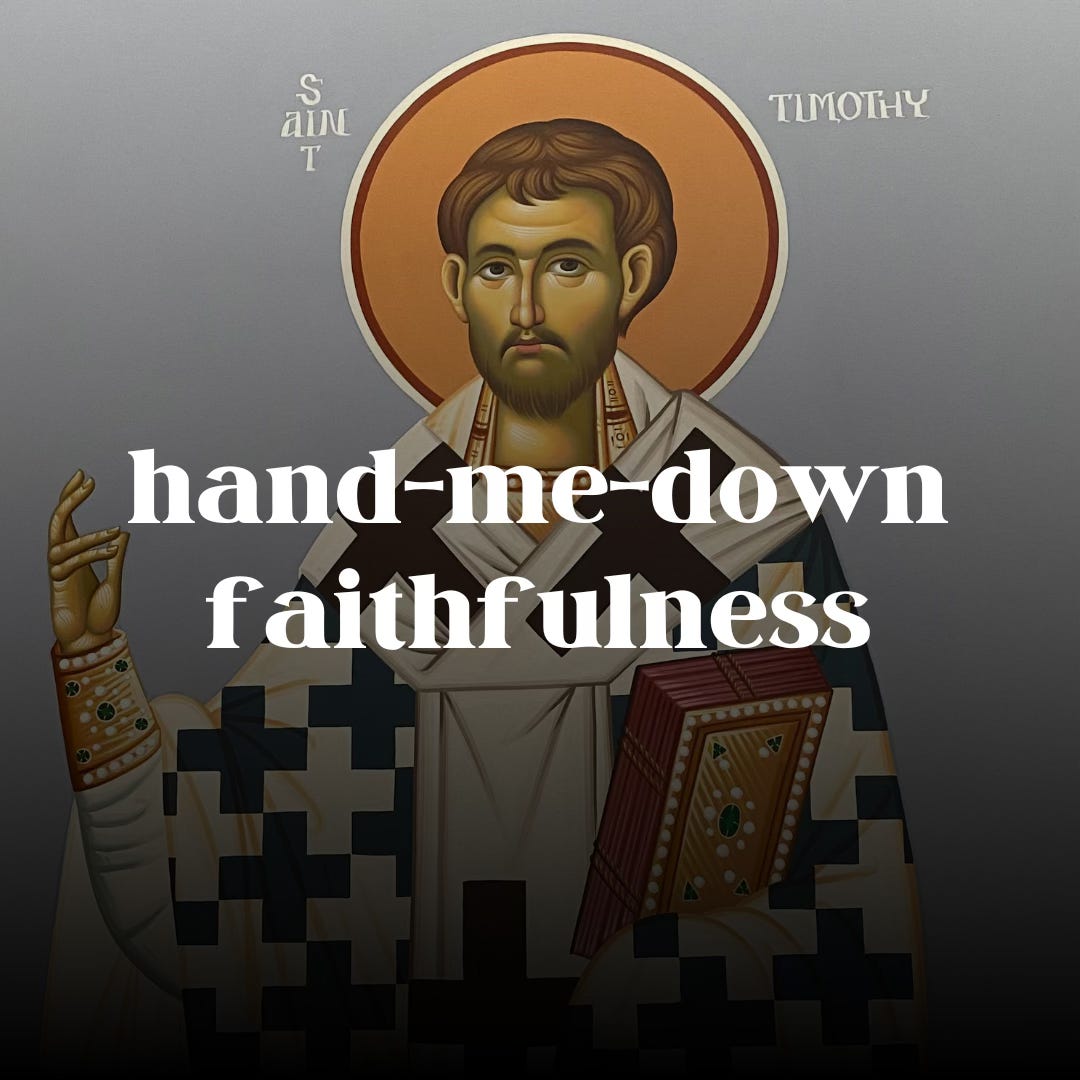
    You then, my child, be strengthened by the grace that is in Christ Jesus, and what you have heard from me in the presence of many witnesses entrust to faithful men, who will be able to teach others also. 1

    The last time we looked at 2 Timothy, Paul held up two possible responses to Paul’s message. You could choose to abandon it like Phygelus and Hermogenes. Or… you could be like Onesiphorous, one who sought Paul earnestly, stayed faithful, and supported him in his hardship.

    As I read over this, I see two actions that Paul wants Timothy to make. Actions that will make him like Onesiphorus.

    Be strengthened

    At this point, we don’t know exactly how long Timothy has been at work in Ephesus, but it’s clear from the tone and content of the letter that Timothy is tired. He is weary.

    What does he need? To remember what he was given, the very gospel of Jesus Christ. To remember who is at work in him, no less than the Holy Spirit himself.

    In other words, he needs to remember that he is a Christian who has been called to the work that he is doing. It is an exhausting, labour-intensive work (this becomes clear as the rest of the chapter unfolds). But it is a work that he has been equipped for.

    Raise up leaders

    Paul also wants Timothy to raise up people who can do the same job as him. Men who are faithful, men who will receive and hand down the very same message that Paul publicly taught. Men who are willing to follow the pattern of Paul’s message but also Paul’s method.

    But we renounced disgraceful, underhanded ways. We refuse to practice cunning or to tamper with God’s word… 2

    A quick flip over to chapter 3 proves why Timothy needs to be instructed to do this.

    As I consider the work that I am doing now, I can understand Timothy’s struggle. He has been sent to a place that has a wolf problem3. Paul is calling him to come to him, to leave this church in a vulnerable position.

    For Timothy to remain faithful, to still be recognised as the genuine article as a gospel minister, he has to be able to let go of the work he is doing in that place. He has to be prepared to hand it down to those who will keep the work going.

    As a church, we are growing and getting stronger. We’re still quite small but there are already Sundays where I don’t get the chance to greet everyone. If things go as we hope, this is a problem that won’t go away.

    So what is there for me to do? I have to be prepared to raise up others in the church to welcome. Though we are able to handle all of the church’s teaching in house, thanks to the presence of gifted and faithful men, there will come a time for all of us to retire from that work.

    One of my early mentors in ministry often talked about how his whole philosophy was trying to work his way out of whatever job he had. He wanted to train people who could take over from him. One of the reasons why I am maintaining a quiet hope regarding the so-called Quiet Revival4, is that the church needs more young men to be saved and trained so that they can continue the work.

    The Christian life is a hand-me-down life. We are given the old, old story to tell so that younger generations can believe the same story. And the pattern repeats.


    1. The Holy Bible: English Standard Version (2016). Wheaton, IL: Crossway Bibles, p. 2 Ti 2:1–2.
    2. The Holy Bible: English Standard Version (2016). Wheaton, IL: Crossway Bibles, p. 2 Co 4:2.
    3. Acts 20:28-31
    4. I do have my reservations
  • new writing at The Habitus

    I’ve started writing my Substack newsletter again. It’s been a while since I last did, but I enjoyed thinking through this as I was writing.

    Thinking about God

  • water, sun, and soil

    I grew up in a Chicago suburb that was bordered by corn fields. Seemingly endless expanses of land where they grow the sweetest corn you’ve ever tasted. In a sense, it is remarkable that this exists at all.

    During planting season, a farmer will drive a tractor pulling a machine that plants seeds. Row after row of seeds are planted. You add water and sunlight and then suddenly a stalk appears with more than one ear in it. Root systems pulling in enough nutrients from soil to grow a single kernel into many.

    What causes this to happen? Such a remarkable thing would surely require huge amounts of effort and expertise and cost.

    But no.

    It happens from ordinary things. Water. Soil. Sunlight.

    One summer, I planted and grew corn. There wasn’t much of a harvest because I had failed to protect the corn from racoons. But corn still grew as a result of ordinary things taking place over time.

    A farmer or a gardener does not balk at the ordinary work, but does it knowing that the results are remarkable. There are various tasks to be done. Clearing weeds, checking the pH of the soil, watering, putting up netting to keep out critters. None of these is remarkable, but over time, the results are.

    A common point of conversation that I have had with people while doing pastoral counselling is that the ordinary things of the Christian life (Acts 2:42) do not feel like they are doing enough. One person spoke of wanting to keep going to church services and gatherings in order to maintain a “spiritual high”.

    Now, it is good to spend time with God’s people but only when we rightly understand what is happening there. If you go to church gatherings expecting another ecstatic experience, you will leave more gatherings disappointed than satisfied. And then you’ll wonder whether your salvation is genuine. Trees don’t grow well if they experience a huge rush of growth followed by stagnation. Strong trees are grown over years.

    Peter, James, and John didn’t spend the whole of their Christian life and ministry on the mountain at the Transfiguration. Instead, they grew day-by-day using the ordinary things provided by God for their good. God’s Word shows us that spiritual growth happens through ordinary means over the course of a lifetime.

  • a humbling fact after years of Bible study

    Like so many others, I welcomed in the year by starting another read-through of the Bible1. I begin at the beginning and that means I’m reading Genesis right now. I’ve read it many times before, especially as I was preparing to preach it in 2023.

    And even as I just read through it again, I find more there than I did last time. How had I not seen so clearly before that the reason why Lot was rescued was because God remembered his covenant with Abraham2? Why hadn’t I noticed the markers of Abraham building altars or planting trees when he calls on the name of the Lord 3? Why hadn’t I noticed just how insistent God was that the blessing would come through Isaac4?

    It is possible to understand the Bible but there is no mastering the Bible. Why? Because the Word of God contains an endless mine with deep veins of gold that can never be exhausted. How could a creature exhaust this?

    This is humbling but it’s also exciting.


    1. I’m using Blue Letter Bible’s Canonical plan this year.
    2. Genesis 19:29
    3. Genesis 12:8; 21:33
    4. Genesis 17:15-21