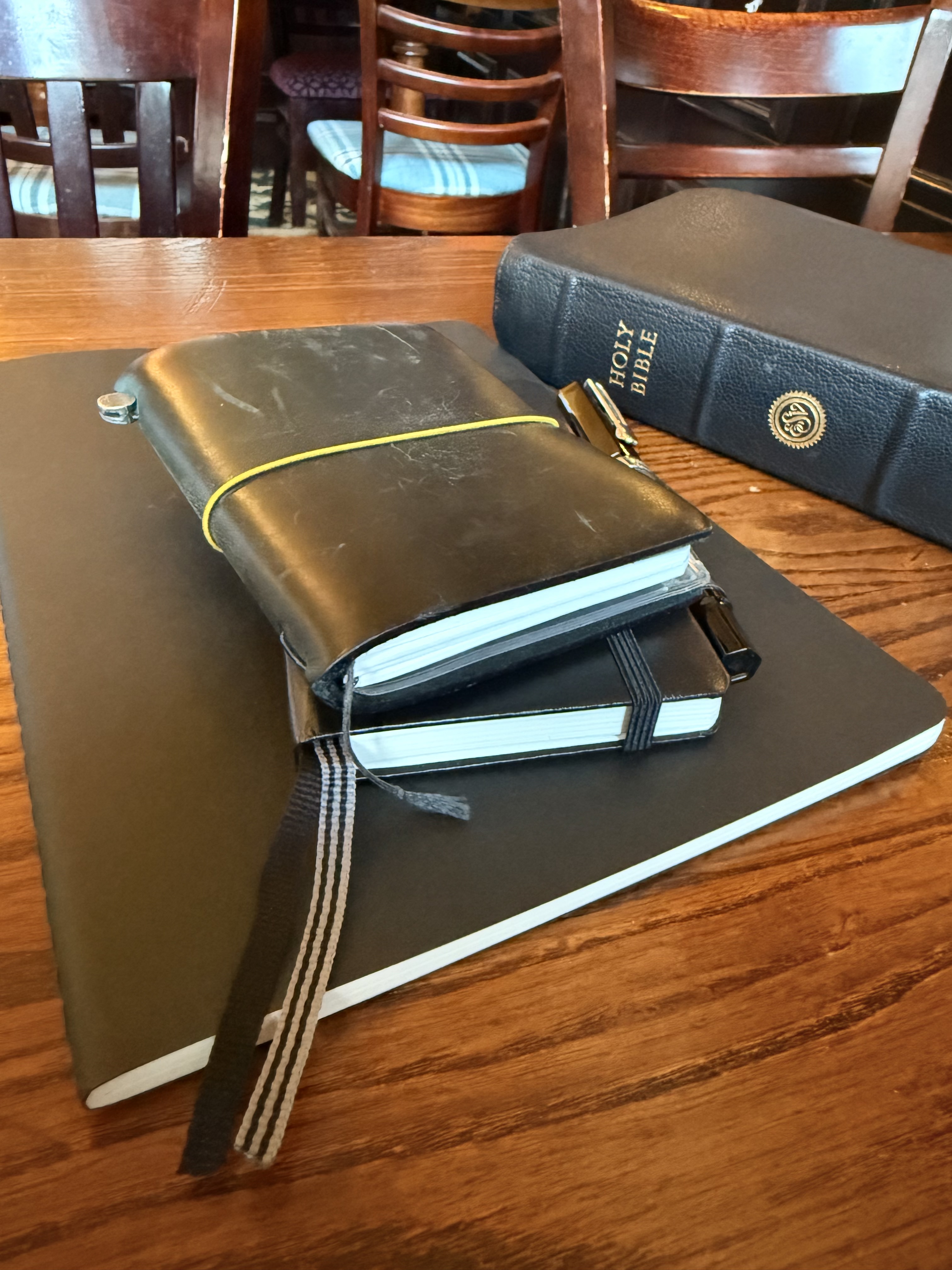
I shared in a note previously that I had figured out my notebook system for the new year. Those who know me in person know that I am a notebook person. All of my sermon prep happens on paper before I type. I’ve been keeping journals for years.
But I also, always, struggle to be settled with my tools. Planner season is a real thing (it runs from October through December) and it is a real struggle. There are so many journal systems that a person can use.
But I think I’ve settled on my system. I share this because it might be useful to you in figuring out how to keep track of your own devotional life. For me, this is how all of my working and thinking gets done. If it isn’t on paper, then it’s probably lost.
The System
The main system consists of three different notebooks. Some may think that’s overkill but it’s as paired down as I can get it for now. I have a Scripture memory/prayer book, a journal, and a sermon book.
Scripture Memory and Prayer
One of my goals this year is to memorise Philippians. It’s a short book so it’s doable, but I also wanted to have it with me at all times.
To make that happen, I managed to find an old resource from over a decade ago: Timmy Brister’s Memory Moleskine. Once I had printed and cut out each of the pages, I found that they just fit into my passport-sized Traveler’s Notebook. Now, when I am out and about or just at home, I have a copy of Philippians which is divided up into sections for memorising so I can practice any time.
To make it even more useful, I added an extra notebook insert where I am collecting short prayers and Scriptures to help me pray more.
The Journal
This notebook is an A6, or pocket-sized, Leuchtturm1917 with a dot-grid. This is where I am copying out my Bible reading plan, keeping track of my thoughts from quiet times, writing out memories, etc. Basically, it’s a journal. It’s where ideas start and where they get recorded.
The Sermon Book
I must say that I am not a technophobe. I am truly against the use of generative AI because it is anti-human, unethical to the core, and has only served to make people think that are accomplishing things when they have actually done nothing.
But I am not a technophobe. I make a use of a lot of digital tools. I even make use of the AI-enabled search in Logos Bible Software because it’s basically the perfect concordance. Very often, I know what a verse says but I can’t remember where it is. It helps me to work more efficiently. But it’s one of the last steps in the sermon-writing process.
The first step is slow, inefficient, and can be painful if the passage is especially long.
I write out my passage, longhand, in pencil in my sermon notebook. That’s where all of my notes and thoughts go. I copy out quotes from commentaries, write out illustrations, outlines, what and why sentences, think through applications… This notebook is where the work happens. I used a Stalogy notebook last year and managed to fit 30 sermons inside it. This year, though, I am using Moleskine Cahier XL notebooks because they’ve added a dot-grid.
I’ve already done my first sermon of the year in it and having the extra breathing room on a page is really helpful.
Two constants that are not pictured here:
My Bible, which is an ESV Preaching Bible in black goatskin. It’s a beast but it has wide margins, good paper, and a font that I can easily read from a glance. I’m into my second year with it and still love it. Each day it gets a bit more useful as I make notes in it.
My miscellanies notebook. This is a black, A5 Leuchtturm1917 hardcover. This is where extended notes end up so that I can save space in my Bible. As of this writing, the most recent note is a basic Bible chronology so that I can keep track of when in history various events happened and people lived.
What about you?
And so that is the system. It’s the result of year of working to figure things out. But what are you using this year? Are you into analogue tools or digital?
2025 has been a year of establishment, growth, and profound loss. When it started, we didn’t know if we would be staying at this church long term. Spring came and went and by the time summer arrived, the church had agreed to bring me on permanently. I started making my biggest inroad into the community by accepting the call to sports chaplaincy.
At the church, we saw 8 baptisms! Half of those were my own children.
And then the autumn came. We were back and forth to England to be there with Tracy’s dad before he died in early October.
Tracy and I celebrated 17 years of marriage. And we’re currently in the process of trying to buy our first home as a family.
Looking back on this year, it feels like we have lived an entire lifetime in the space of twelve months.
As we get ready for 2026, I wanted to share my last sermon of the year. It’s the fourth one that I’ve written in the last week. It might be the most important one of the year, at least for me to look back on. You can watch the video below or read the transcript for it.
It cannot be said enough that it is really important to know what you believe. When you know what you believe, you’re able to understand what is going on around you and how your beliefs will affect those things. This series is on The Big Five. Five big truths about God, his word, salvation, and life. These truths tell us what we are.
Where we’ve been so far…
So far in this series, we have learned that the Bible is perfect, enough, and in charge. The Bible is perfect because it comes from God. It’s his instruction for us about himself and about the world we live in. Because it comes from God, the Bible is in charge. The elders here don’t get to teach things that go against the Bible. In fact, if we do that, then God’s curse should be on us.
That’s why it’s so important for everyone in the church to know what the Bible says, so that you know how to spot false teaching.
Then, Douglas taught us that Jesus is the only way to salvation. Jesus himself taught this when he said to his disciples that he is the Way, the Truth, and the Life, no one comes to the Father except through him.
The Bible is in charge and the Bible tells us that salvation is only found in Christ. There’s no where else you can go to be saved.
But then there is a question which has divided the church for the last 500 years.
How do you actually get saved? Is salvation something that we do all on our own? Is salvation us working together with God? Or… Is salvation the work of God alone, given to us in love founded upon the life and work and Jesus Christ?
We’ll start by looking at a bit of God’s word and then we’ll see how all of this is good news for anyone who is thinking about the year that is ending and the year to come.
And you were dead in the trespasses and sins in which you once walked, following the course of this world, following the prince of the power of the air, the spirit that is now at work in the sons of disobedience—among whom we all once lived in the passions of our flesh, carrying out the desires of the body and the mind, and were by nature children of wrath, like the rest of mankind. But God, being rich in mercy, because of the great love with which he loved us, even when we were dead in our trespasses, made us alive together with Christ—by grace you have been saved— and raised us up with him and seated us with him in the heavenly places in Christ Jesus, so that in the coming ages he might show the immeasurable riches of his grace in kindness toward us in Christ Jesus. For by grace you have been saved through faith. And this is not your own doing; it is the gift of God, not a result of works, so that no one may boast. For we are his workmanship, created in Christ Jesus for good works, which God prepared beforehand, that we should walk in them.(Eph. 2:1-10)
What is grace?
Grace is one of those words that we use a lot in church but never actually get around to defining. Christians seem to know what it is without actually saying.
For us today, I worked hard at this to help us all understand it:
Grace is God’s unearned kindness freely given to sinners.
Grace is God’s…
The first thing for us to know about grace is that grace comes from God. God is always the one who acts first.
In Genesis 3:6-9, Adam and Eve tried to hide from God. They had broken his Law and wanted nothing to do with him. The very thought of his presence filled them with fear.
And so God pursued them. He called to them. Even at the very beginning of creation’s fall, God acted first. So it would seem that salvation comes from God alone.
And what did he give?
Unearned kindness
What could God have rightly done when Adam and Eve sinned? He could have killed them there and then. And that would have been right. Instead, he speaks to them.
Their rebellion carries consequences but God is still kind to them. He curses the serpent and tells the serpent that one day he will be destroyed. He tells the woman that she will experience pain in childbearing. He tells the man that the ground is going to frustrate his work.
How is this kindness? Because the one who led them astray would be punished. Because, though there would be pain in childbearing, there would still be childbearing. The birth of a child is still a cause for joy. We rejoiced as a church family last year at the birth of baby Benjamin. We rejoice together this year at the birth of Keziah.
The man had been given the task of working and keeping the garden. Though he would be expelled from the garden, though his work would be frustrated, he would still have work. Work is a gift from God to man for man needs a purpose.
Given to sinners
What cannot be missed in this is that this kindness is given to sinners. Adam and Eve had earned punishment and destruction. They deserved death, but God gave them kindness.
Why?
Why would God give this kindness to people who don’t deserve it? It goes right back to the beginning. Because God loves.
So, grace is God’s unearned kindness given to sinners. Just as Adam and Eve did not, and could not, do anything to cover up the fact that they sinned, so we can do nothing to earn our salvation.
The Canadian apologist, Wes Huff puts it this way:
“In all other systems of religiosity, it’s some form of survival of the fittest, right? It’s some form of do this and you’re accepted, feel this and you’re accepted, or think this and you’re accepted. Intellectualism, emotionalism and experimentalism. It’s one of those three things. However, Christianity says you can’t feel, do, or think enough. It’s not going to work. You’re not going to live up to the standard of a holy God. And so, it’s not survival of the fittest. It’s not the most intelligent or the most spiritual or the people who have the greatest revelations. Instead, the fittest steps down and sacrifices himself for the survival of the weakest. That’s what we call the gospel.”1
Why does any of that matter, then? It matters because it is good news in three different ways.
Grace is good news for the world
If God gives unearned kindness to sinners, that is incredibly good news for the world. The world is full of sinners. You and I are sinners. When was the last time you really thought about that fact?
I am a sinner. I am in the world and I am a sinner. I am someone who has walked in darkness rather than the light. And yet, God gives his grace to me. I didn’t earn it because I couldn’t earn it and yet God gives it to me.
And his grace to sinners doesn’t even start with their salvation.
In the Sermon on the Mount, Jesus teaches that God makes it rain on the righteous and the wicked. Good people and bad people alike get to experience simple gifts like life, food, people, the opportunity to behold the wonders of God’s creation wherever we are.
There’s a poet called Britta Benson. She moved to Scotland something like 25 years ago from German and she’s an artist in residence at a centre in Paisley. She has a series of photographs on her blog where she finds natural beauty in unexpected places like the edges of disused carparks. There on the border between the tame and untamed, flowers begin to grow, greenery sneaks its way in. This is common grace.
But God also gives special, saving grace to an undeserving world. What does John 3:16 say? Because God loves the world, whoever believes in his Son will not perish but receive eternal life. Salvation is by grace alone. This is good news for the world and it’s good news which we should seek to share.
Grace is good news for those looking back
Who here likes to sing Because He Lives? It’s a great song that tells us of the great hope we have because Jesus Christ is alive. But it misses one important thing.
A pastor I know back in the States once pointed this out. It’s all well and good to be able to face tomorrow.
But Jesus’s resurrection and present reign, his grace, means that I can face yesterday.
Who here started the year with resolutions and good intentions? And how many are on track to finish their Bible reading plans on Wednesday?
Who here managed to make it through without sinning? Like, it’s just been a really good year where you did everything right and you’re looking back at it all and feeling really good. Is that the case for any of us?
Well, if you didn’t have that kind of year, then I have good news. God’s unearned kindness is freely given to you in Christ. You didn’t earn it in the first place and you can’t lose it. He has given it to you and he does not change.
We’ve come back to these words a lot this year, it seems, and that’s no bad thing.
This is the message we have heard from him and proclaim to you, that God is light, and in him is no darkness at all. If we say we have fellowship with him while we walk in darkness, we lie and do not practice the truth. But if we walk in the light, as he is in the light, we have fellowship with one another, and the blood of Jesus his Son cleanses us from all sin. If we say we have no sin, we deceive ourselves, and the truth is not in us. If we confess our sins, he is faithful and just to forgive us our sins and to cleanse us from all unrighteousness. If we say we have not sinned, we make him a liar, and his word is not in us. (1 John 1:5-10)
If you’ve messed up, and you know you have; if you didn’t reach your goals; you are still saved by grace.
What then shall we say to these things? If God is for us, who can be against us? He who did not spare his own Son but gave him up for us all, how will he not also with him graciously give us all things? Who shall bring any charge against God’s elect? It is God who justifies. Who is to condemn? Christ Jesus is the one who died—more than that, who was raised—who is at the right hand of God, who indeed is interceding for us. Who shall separate us from the love of Christ? Shall tribulation, or distress, or persecution, or famine, or nakedness, or danger, or sword? As it is written,
“For your sake we are being killed all the day long;
we are regarded as sheep to be slaughtered.”
No, in all these things we are more than conquerors through him who loved us. For I am sure that neither death nor life, nor angels nor rulers, nor things present nor things to come, nor powers, nor height nor depth, nor anything else in all creation, will be able to separate us from the love of God in Christ Jesus our Lord. (Romans 8:31-39)
If you belong to Jesus, then God is for you. It doesn’t rest on your performance but on his.
Salvation by grace alone is good news for yesterday.
Grace is good news for the future
Perhaps you’re looking ahead to the next year and wondering how you will make it through. You are worried that you’re going to mess something up, that maybe there is something you can do that will mean God takes away his grace from you.
Brothers and sisters, that is the voice of the enemy. You didn’t earn your salvation in the first place and you don’t keep yourself saved. Any good that you might do is purely as a result of your salvation.
Consider this in Philippians 2:12-13.
Therefore, my beloved, as you have always obeyed, so now, not only as in my presence but much more in my absence, work out your own salvation with fear and trembling, for it is God who works in you, both to will and to work for his good pleasure.
It might seem like Paul is telling the church in Philippi that they have to earn their salvation, but look what it says. Work it out because God works in you. He works in you the desire to please God and he works in you the ability to please God. This is grace.
The good works that you are called to do as a believer in Jesus are only possibly because you have already received God’s grace.
And your salvation is not kept by you alone but by the Holy Spirit at work in you.
By the Holy Spirit who dwells within us, guard the good deposit entrusted to you. (2 Tim. 1:14)
What about at the very end of your life? Who will keep you saved then? It is God by his grace.
For by a single offering he has perfected for all time those who are being sanctified. (Heb. 10:14)
Conclusion
God’s grace is his unearned kindness given to sinners. If this is all true, what does it mean for how we live?
First, come to Jesus. How is it possible to experience this grace, this kindness? The only way is by coming to Jesus. He offers his grace to you regardless of what you have done. Everything that you are doing in life is pointing you toward this one desire. Your heart is longing to be made right with its Maker. That’s why nothing is ever enough. So come to the one who can satisfy that desire.
Second, rejoice and be amazed at the grace of God. If there is one thing for you to keep in mind as you reflect on the last year and all that has happened, let it be this. Whether it went well, badly, or a mix, you are here today because God has given you his kindness in Jesus. You don’t deserve it yet he still gave it. Rejoice and be amazed.
Third, be encouraged as you do good. You’re not doing good things in order to earn God’s smile, you’re doing them because he has already smiled upon you. So pursue those good works while being motivated by the fact that God has given them to you as a gift. How much better to be given the opportunity to do good than to do bad.
Lastly, extend this grace to others. If they don’t know the grace of Jesus, tell them about him. Bring them along to Life Explored. It would be great to not have enough handbooks for it. Or if they have hurt you, extend grace to them. Offer them forgiveness. No, they don’t deserve it. But neither do you.
Carl Trueman writes:
“Grace assumes tragedy. It is because the world is not as it should be that God is gracious.”
Grace doesn’t mean everything is okay, it’s there because things are not okay. But God’s grace is given freely to you as you believe in Jesus.
His grace has led you here thus far and his grace will lead you home to him. So come to him. Experience the grace of communion with Christ as we come to the Lord’s Table.
Receive from Christ what he gives, he gives himself.
Before I get to the actual post, I am still working on a big article which will be a reflection of all of my thoughts so far on 2 Thessalonians. It turns out that trying to distill four sermons, several weeks of study, and pages and pages of handwritten notes into something coherent is actually quite a big task to undertake during Advent. In the meantime, I’ll be sharing my weekly devotional thought which I send out to our church.
And now, Father, glorify me in your own presence with the glory that I had with you before the world existed. (John 17:5)
When fame and riches come to someone, there is a shift in their attitude toward others. In some cases, the person is motivated toward charity and using their position for the good of others. In most cases, it would be safe to say that they see their position as an excuse to distance themselves from others.
Perhaps they are seeking safety. Perhaps they are just not wanting to be used by people. But then there are some who will feel that the gift they’ve been given was actually coming to them anyway. That they deserved to be given a particular talent or ability which led to them being recognised by people.
When we look at Jesus, we see that he chooses an option that none of us would choose on our own. In the time before his Incarnation, the Word was in glory, glorified by the Father. This was a glory which was rightly his for he is very God of very God, Light of Light eternal.
What did Jesus do with this glory? He did not allow it to keep him from us but stepped into history as one of us, yet without sin.
This Advent, we will consider Jesus, his glory, and his accomplishing of his Father’s will so that we might take part in his glory (2 Thess. 1:12).
I decided it was time to renew my personal blog. While I have made a point of posted more regularly over on my Substack, I have wanted to have a place that feels like it is both a timeline and a potential resource for the church later on. I don’t know yet what it will look like, but I have had thoughts of what I might like to share. It’s mainly things that wouldn’t fit into a weekly-ish newsletter.
And so, because I’m committed to not spamming people, I’ve deleted all of the subscribers that previously lived here. They’ll still get my Substack articles, but they’ll have to actively choose to subscribe here again.
I may be sharing about the grieving process here as well because that’s where our family is at just now.