Category: Tools

  • how I have been using morning pages

    As a person who is interested in the creative process and particularly in the use of the written word, I like the idea of morning pages but also find the way that people talk about them to be sort of… we’ll say I find it off-putting.

    That being said, a practice that I have found helpful in recent weeks is the simple act of writing 750 words everyday.

    I was reminded of this resource recently when an email came through telling me that they’d moved it to a new online platform and that I still had access to my legacy account because I joined it all the way back in… September 2012. I’m not being paid in any way to mention the fact that I use this. They have a paid plan now but I’ve already got enough stuff to pay for. But you may find it worth it, especially if you want to support an independent developer.

    For me, there are three things that I get out of 750words:

    A place to spill out words

    When I say spill, I really do mean spill. It’s a place that keeps track of the number of words I am writing for me and it does a bit of analysing of them and tells me broadly how I seem to be processing things. It tells me if I’m thinking more about myself (using I/me pronouns) or about others (they/them). It gives me a clue as to the things that I am thinking about. It generates a sort of word-cloud so that I can see what seems to be most present on my mind. And so, for me, it’s almost a place to think out loud.

    I don’t have to think about what to do with the words

    When it comes to my work or my own personal writing, a lot of thought goes into figuring out where to keep the words that I am producing. Is this a note on a Bible passage? Is it a shopping list? Is it some thoughts on this chapter of this book? Is it for a project?

    All of those things have to go to different places. I get quite… anxious about losing work or losing things that are potentially useful. But my 750 words don’t have to be useful. They are in that moment, but they don’t have to make their way into a system. Sometimes they do because I realise that I am thinking quite clearly about a thing.

    Mostly? I take a look at the insights it has made on my writing and don’t look at it again. And that is quite freeing.

    I’m not concerned about data loss

    Related to the previous point, once I have had a sense of what I seem to be thinking about, I don’t actually need my words to be preserved. The team there does do that, but it doesn’t make or break the whole thing for me. I even have the option of exporting all of my words to archive elsewhere, but I haven’t done that yet. I don’t know that I will.
  • some resources I’ve found helpful

    For a long time, I used Reeder Classic to keep up with blogs and things. With the most recent update, though, I’ve moved to the new version of it.

    I’ve enjoyed having a sort of personalised feed of the internet, alongside things like bookmarks for reading later. One feature that got added, is the ability to have shared feeds. I’m not using this feature very heavily, but I do have shared feeds for discipleship and prayer. When I read an article that I find helpful or encouraging, it gets added to the feed.

  • two mindset changes that have helped my writing recently

    two mindset changes that have helped my writing recently

    I just finished up Day 10 of the note-taking challenge and I’ve already noticed a couple of things change in my writing since the start.

    letting things be messy

    Bianca Pereira, the creator of the challenge, addressed what she calls a ”completionist mindset”. It’s the sort of mindset that wants a notes system to be perfectly organised and for each note to be “complete”. Her point with this is that over time, our knowledge will change and we will necessarily have to edit, amend, or even completely overhaul our notes on a particular topic. So rather than trying to make perfect, little atomic notes, it makes a lot more sense to just embrace a bit of messiness to the whole endeavour.

    For my own practice, this has meant that the majority of my notes from the challenge are living in a notebook I had set aside as a place for “complete notes”. Now, it’s a much more accessible notebook and it means I’m much more likely to browse through it because I don’t have to be so precious about everything.

    I’ve even had to embrace this in ministry. There is a certain amount of mess that comes with it because the work of ministry is a work with a diverse group of people. While it is good to strive for excellence in the things that we do, it’s also very good to strive for just seeing the work getting done. If we keep pushing for perfection in everything then everyone becomes afraid of messing up and there’s no room for risk or taking a chance on things.

    free-writing is actually good?

    As a teenager, I would fill notebooks with scrawling diatribes about nothing in particular. Before we left America for the first time back in 2010, I burned all of my old journals. The world is a better place without them. You’re welcome.

    Those notebooks were full of free-writing. Just page after page of stream-of-consciousness gibberish that wasn’t going to do anyone any good.

    But over the last 10 days, I have been forced to do free-writing. Many of the prompts have included free-writing. What has been helpful during these writing sessions is that there are some guard-rails up to guide the free-writing. It isn’t just, “write!” but, “Look at this list of things you wrote the other day. Pick one of those things and answer this question in relation to that.”

    Doing that has led to more writing and to more thinking about other things that I have been writing. It has helped me to effectively use the page in front of me as a means of processing rather than just a blank canvas upon which to splatter paint.

  • my current notebook setup – September 2024

    my current notebook setup – September 2024

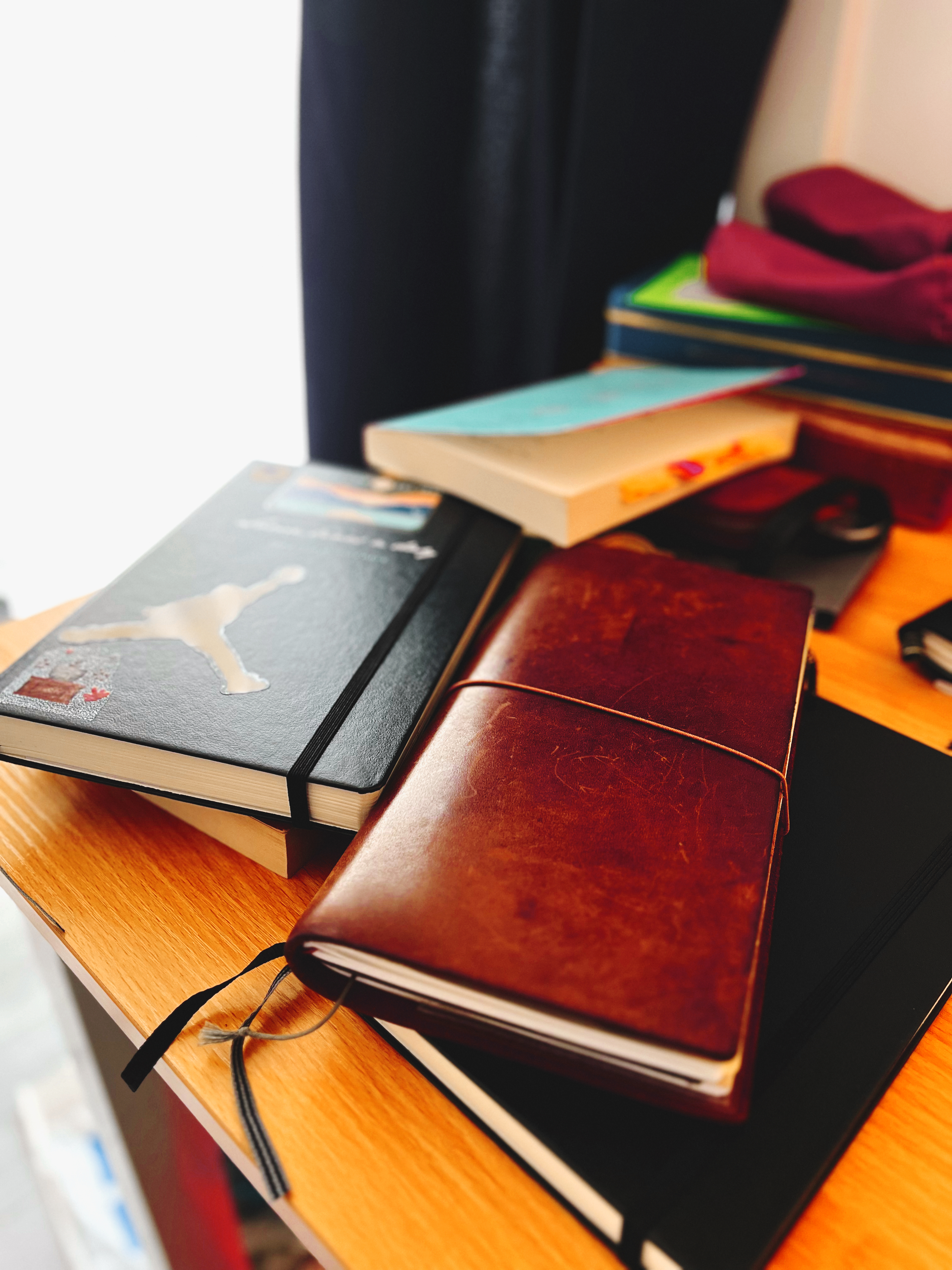
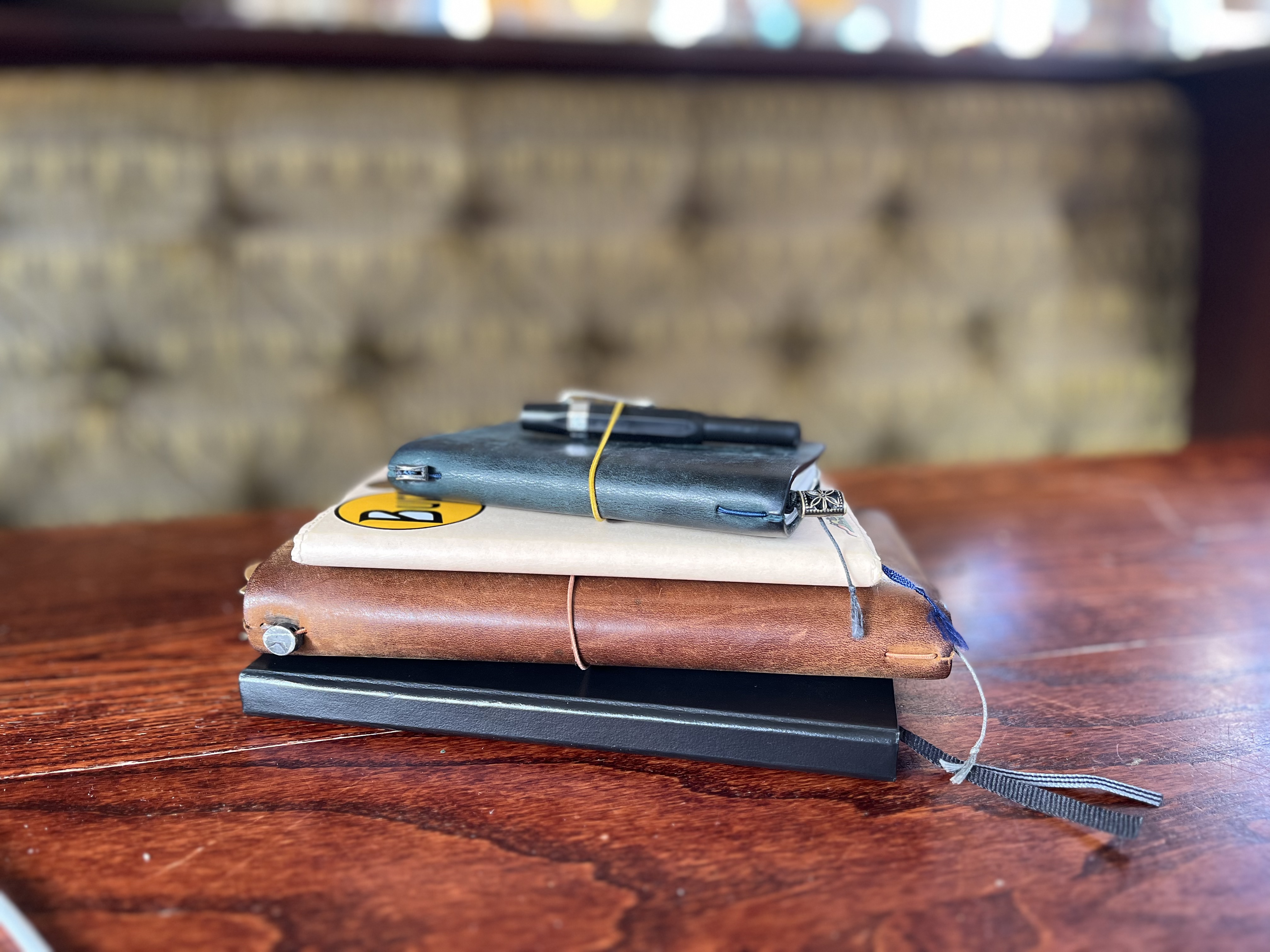
    As a stationery addict, I carry more notebooks than is probably practical for most people. I do plan on consolidating this a bit as these do make my bag quite heavy.

    From top to bottom:

    1. Traveler’s Notebook – Passport size in navy.

    It holds two Baron Fig Vanguard notebooks at the moment. One refill serves as a standard pocket notebook. I use it for notes throughout the day, writing out bullet points for my pastoral prayer each week (I’ll write about that at some point). The other refill is where I have my handwritten version of 1 Peter along with notes and journal entries on the book. If I have a spare moment I’ll give it a skim and note down any thoughts.

    2. MD Paper slim B6 with paper cover

    This one is my commonplace book. It’s where I write down quotes or poems or things.

    3. Traveler’s Notebook – Camel

    This is loaded with two refills. One is my regular journal. It’s where I think and reflect. The other is my sermon workbook. I write out the passage, make notes and figure out structure stuff. At the moment I’m using the light paper refills. They work well with fountain pens and I like the thin paper.

    4. Leuchtturm1917 A5

    This is my “miscellanies” book. I’ve only recently started using it again (my previous entry was from April 2023!). At the moment I am also using it to complete a 100 Days Of Notetaking challenge.

  • 📓New additions to the analogue system

    I wrote recently about how I had finally figured out a sort of default setting for my analogue system. Today, a couple of things arrived in the post to help make that system even better.

    Traveler’s Company archive binder

    I’ve been using a Traveler’s Notebook of some sort since they were still under the Midori brand. It’s safe to say that I’ve got quite a few used refills knocking about in various places. Now, I’ve finally bitten the bullet and ordered myself some of the archive binders. They’re purpose-built, they look nice together on a shelf, and they help keep all my refills together in a way that lets me flip through them for reference.

    Now I just need to make the shelf-space for them!

    Field Notes Front Page

    I’ve been using a pocket notebook quite a bit lately and wondered if I would benefit from switching to a reporter-style one. Something that can sit next to my iPad or whatever book I might be reading at the time.

    Because I can never just use whatever notebooks are available, I decided to give Field Notes’ Front Page a go. Will have to report back on this one but it feels great in the hand and is the same height as my Traveler’s Notebook.